Palmistry reading ha
What Is Palmistry, Really?
Palmistry — sometimes called chiromancy — is the age-old practice of reading the lines, shapes, and fleshy mounts of the hand. You'll find versions of it in cultures all over the world, from ancient Asian traditions to European folk customs, stretching back centuries. The big idea underneath it all is pretty simple: your hands carry a map of your personality, your habits, and your emotional patterns. And if you're curious about how to read your palm lines for love, that map is exactly where you start.
Now, before you roll your eyes — hear this out. Modern palm readers aren't out here claiming your hands lock you into some fixed destiny. Most pros treat palmistry as a tool for self-reflection and personal insight. One industry expert recently put it this way: "Your palm lines are less a crystal ball and more a mirror." That framing lands especially well in 2026, when people want personalized insight way more than rigid fortune-telling. If you've been wondering how to read your palm lines for love, think of it as journaling with your own hand as the page.
Why Understanding Palmistry Matters in 2026
Here's the cool part: palmistry isn't some dusty relic. Wellness platforms report that palmistry content has become one of the fastest-growing categories in their self-discovery sections. People are craving screen-free, tangible ways to understand themselves — and your own palm is about as analog as it gets. Learning how to read your palm lines for love taps into that same hunger for mindfulness and emotional awareness. It's a moment of stillness, a pause button on the endless scroll of modern dating.
Why Palm Reading for Love Is So Popular Right Now
Let's be honest — love is the number one topic people ask about when they get a palm reading. According to data shared by several well-known platforms in the wellness space, searches around relationship-focused palmistry have climbed steadily over the past few years. A senior practitioner at a leading holistic wellness brand noted that "nearly seven out of ten clients want to talk about romance first." That's a whole lot of people eager to learn how to read your palm lines for love.
Why the surge? Partly because dating has gotten more complicated than ever. With so many ways to connect and disconnect, people are hungry for clarity about their own emotional patterns. Palmistry offers a tangible, screen-free way to reflect on how you approach intimacy. And unlike generic personality quizzes, your palm lines are uniquely yours — which is exactly why how to read your palm lines for love feels so personal.
Getting Started: Which Hand Do You Read for Love?
- Your dominant hand (the one you write with) shows your present self — the patterns you've developed and the choices you're actively making.
- Your non-dominant hand reveals your innate potential — the traits you were born with and the tendencies you inherited.
For love readings, most practitioners compare both hands side by side. The contrast tells a story: what you started with versus what you've built. If your heart line looks very different on each hand, that's often a sign of significant emotional growth or change over your lifetime. Before you dive into how to read your palm lines for love, always check both palms.
A Quick Note on Hand Shape and Elemental Types
Before diving into lines, look at your overall hand shape. In palmistry, hands are generally grouped into elemental types — earth, air, fire, and water. Water hands (long palms, long fingers) are traditionally linked to emotional depth and romantic sensitivity. Fire hands (square palms, shorter fingers) often signal passion and spontaneity. Knowing your hand type gives context to everything else — including how to read your palm lines for love with real nuance.
The Major Palm Lines You Need to Know
1. The Heart Line: Your Emotional Blueprint for Romance and Relationships
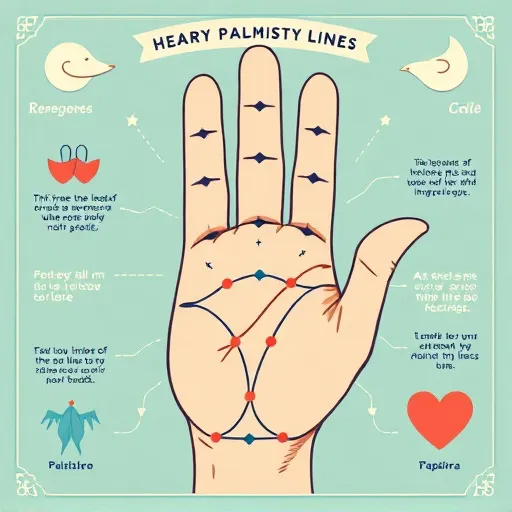
This is the star of the show for love readings. The heart line runs horizontally across the upper portion of your palm, starting under your pinky finger and extending toward your index or middle finger. It reflects your emotional style — how you give love, how you receive it, and how you process feelings. Anyone serious about how to read your palm lines for love needs to master this line first.
- Starting point: Under the index finger? You're idealistic and romantic. Under the middle finger? You're more practical and grounded in love. Between the two? A balanced blend of head and heart.
- Depth and clarity: A deep, clear heart line suggests strong emotional capacity. A faint one can indicate someone who keeps feelings guarded — or who's still learning to open up.
- Curves and straightness: A gently curved line points to expressiveness and warmth. A straighter one often belongs to someone who shows love through actions rather than words.
- Breaks or chains: Small breaks don't mean heartbreak — they typically suggest emotional turning points or transitions. Chained (feathery) lines can indicate a sensitive, sometimes overthinking heart.
One seasoned practitioner at a well-known holistic platform likes to remind clients: "A broken heart line isn't a bad omen. It's usually just punctuation — a pause, not a period." That's a reassuring note whenever you're learning how to read your palm lines for love.
2. The Marriage Line: Relationship Lines Under the Pinky Finger
These are the small, fine lines on the edge of your palm beneath your pinky finger, just above the heart line. They're sometimes called affection lines or union lines. Contrary to popular belief, they don't literally count marriages — sorry to disappoint! Instead, they're read as markers of significant emotional attachments and deep bonds.
- Number of lines: You might have one, two, or several. More lines don't mean more marriages — they can indicate multiple meaningful relationships over a lifetime.
- Clarity: A clear, well-defined marriage line suggests a strong, stable connection. Faint lines may point to relationships that are more casual or still developing.
- Position: The closer the line sits to the heart line, the earlier in life the attachment is traditionally thought to occur. Lines near the pinky finger are associated with later-in-life partnership bonds.
- Forks: A forked marriage line is often interpreted as a partnership involving mutual growth — two paths running together.
3. The Head Line: Logic, Intuition, and Communication in Love
The head line runs horizontally across the middle of your palm, above the life line. In love readings, it reveals how you think about relationships — whether you lead with logic or let intuition guide you. A long, sloping head line often belongs to someone imaginative and romantic in their thinking. A shorter, straighter one suggests a pragmatic approach to partnership and commitment. When learning how to read your palm lines for love, this line gives you the mental side of the story.
4. The Life Line: Vitality, Stability, and Long-Term Compatibility
The life line curves around the base of your thumb. While it's primarily associated with vitality and your life path, it also adds context for love — especially around major transitions. A clear, unbroken life line is traditionally read as steady energy and stability, which naturally supports long-term relationships and compatibility.
Reading the Mounts for Love Compatibility
- The Mount of Venus (the pad at the base of your thumb): This is the love mount. A full, well-developed Venus mount is associated with warmth, passion, and a generous heart. A flatter one can suggest someone more reserved emotionally.
- The Mount of Moon (the lower edge of your palm opposite the thumb): This mount relates to intuition and imagination. A prominent Moon mount often belongs to romantics and dreamers — people who feel deeply and love creatively.
A practitioner at a leading wellness brand once explained it this way: "The lines tell you the story; the mounts tell you the tone. You need both to hear the full message." So when you're figuring out how to read your palm lines for love, don't skip the mounts — they add the emotional texture.
Common Myths About Palm Reading for Love
- Myth: Your palm lines are fixed forever. Reality: Many palmists note that lines can shift subtly over time as your habits and emotions change. Your palm is a living document.
- Myth: A short heart line means you're cold. Reality: It often just means you express affection differently — through loyalty, acts of service, or quiet consistency.
- Myth: Palmistry can tell you exactly who you'll marry. Reality: No ethical reader will claim that. Palmistry highlights patterns, not specific people or dates.
- Myth: You need a professional to read your palm. Reality: You can absolutely learn how to read your palm lines for love on your own — that's exactly what this guide is for.
How to Do a Self-Reading: Step by Step
- Find good lighting. Natural light works best. Hold your palm flat and relaxed.
- Identify your dominant hand and your heart line. Trace it gently with your other index finger.
- Note the starting point — under the index finger (idealistic), middle finger (practical), or between (balanced).
- Check the depth and texture. Is it deep or faint? Smooth or chained?
- Look for curves, forks, and breaks. Each has its own interpretation, as covered above.
- Locate your marriage lines beneath the pinky finger. Count them, note their clarity and position.
- Compare both hands. What's different? What's consistent? The differences often tell the most interesting story.
- Reflect, don't predict. Ask yourself: does this resonate with how I actually show up in relationships?
Take notes. Many people sketch their palm or snap a photo so they can compare in a year's time. You might be surprised at how much shifts — and it's a great way to track your progress with how to read your palm lines for love.
What to Do With What You Learn
- If your heart line is faint: Consider whether you've been guarding your emotions. What would it look like to let one person in just a little more?
- If your heart line is chained: You may overthink emotional situations. Try journaling before reacting to relationship stress.
- If you have multiple clear marriage lines: You likely form deep bonds easily. Make sure you're giving yourself time to breathe between connections.
- If your Venus mount is flat: Ask yourself whether you're giving yourself permission to enjoy pleasure, affection, and rest.
A respected voice in the holistic space recently shared advice worth repeating: "The best palm reading leaves you with better questions, not fixed answers." Use your palm lines as prompts for honest self-inquiry — that's where the real value of how to read your palm lines for love lives.
The 2026 Angle: Why Palmistry Matters More Than Ever
In a world of endless swiping and algorithm-driven matchmaking, palmistry offers something refreshingly analog: your own hands, your own attention, your own reflection. It's a moment of stillness. And interestingly, some wellness platforms report that palmistry content has become one of the fastest-growing categories in their self-discovery sections. Whether you treat it as a spiritual practice, a fun party trick, or a journaling prompt, how to read your palm lines for love is ultimately about getting to know yourself better. And self-knowledge, as any relationship expert will tell you, is the foundation of every healthy partnership.
Frequently Asked Questions
Which Palm Line Is Most Important for Love and Romance?
The heart line is the primary line for love readings, followed closely by the marriage lines on the edge of the palm beneath the pinky finger. Together, they're the core of how to read your palm lines for love.
Can My Palm Lines Change Over Time?
Many practitioners observe that palm lines can shift subtly as your habits and emotional patterns evolve. Think of them as a living map rather than a fixed blueprint — which makes revisiting how to read your palm lines for love worthwhile year after year.
Do I Need a Professional Palm Reader?
No. With the guidance in this article, you can do a meaningful self-reading. Professionals can offer deeper interpretation, but self-reading is a powerful starting point for how to read your palm lines for love.
Is Palmistry Scientifically Proven?
Palmistry is not a science. Most modern practitioners frame it as a reflective and interpretive practice rather than a predictive one. Approach it with curiosity, not certainty.